
The Financial Magicians
Now you see your money, now you don’t!

Introduction
I worked as a loan officer and mortgage broker for a handful of companies from 2000 to 2008. I closed around 200 loans. Of those, only 2 defaulted, both due to client negligence. As I recall, in that 8 year period, the most I ever netted in one year was around $36,000 dollars. For the last 2 years of that employment, I worked in a US East Coast city with a population of over 1 million people. In that period, I personally witnessed some of the most egregious acts of fraud and theft by so-called mortgage professionals and real estate agents. Some of these would steal tens of thousands of dollars from their own family members. Loyalty was lost and the disease of avarice had saturated the mortgage lending culture.
Due to the recent financial eruptions in the US that began in March of this year, i.e., the insolvency of First Republic Bank, Silicon Valley Bank, and Signature Bank. And again seeing billions of dollars being shifted from point - A (the government) to point - B ( wealthy bank associates) through these banks, the financial ghouls of the 2008 mortgage crisis crawled from the recesses of my memory to center stage for a repeat performance. Welcome to the show.
Setting the Stage
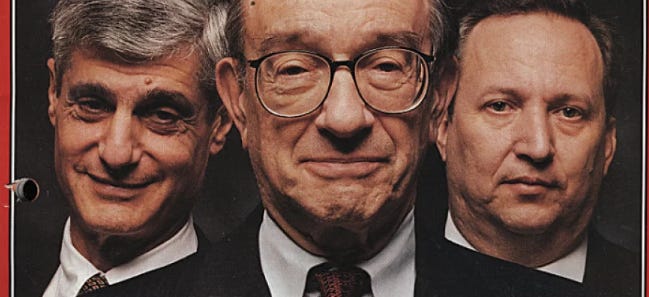
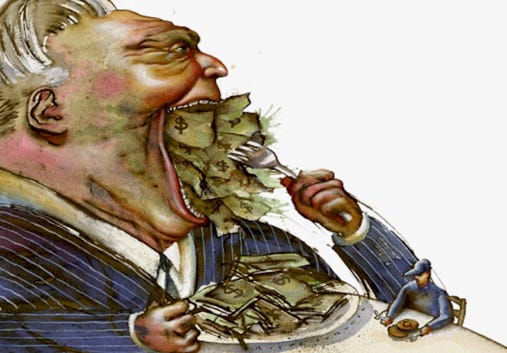
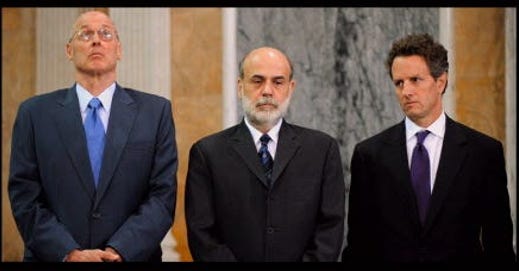
They created an atmosphere for the perfect financial storm, and then set agents in place to guarantee its fruition. They walked away from the economic devastation of multi-millionaires, as trillions of dollars in private losses became public debts balanced on the shoulders of US taxpayers for generations to come. To those they made rich it was magic, to those they made poor it was tragic. All three pictured above operated out of the economic ideology that commercial banks, security firms, and investment banks had no need for government regulations and that the Glass-Steagall Act of 1933 put unnecessary limits on economic growth.
Despite the warning eight days earlier, from Michigan Congressman John Dingell, that “we are creating institutions that are too big to fail,” on November 12th 1999, Bill Clinton signed the Gramm-Leach-Bliley Financial Act, that removed the Glass-Steagall separation between commercial banks, investment banks, security and insurance firms. This signing opened the door to immeasurable conflicts of interest in the US banking- investment industry, and in the halls of power in the US government.
An earlier warning about Wall Street bankers operating beyond regulation had been issued by the head of the Commodities Futures Trade Commission (CFTC), Brooksley Born. She became concerned that there was no transparency or regulatory oversight for over- the- counter derivatives that were traded outside the purview of the public exchange. Under the direction of Born the CFTC issued a Concept Release Paper on May 7th, 1998, citing a 1997 report from the General Accounting Office(GAO) that identified, “360 substantial end-user losses,” in financial derivative transactions due to fraud and manipulation.
The Chairman of the Federal Reserve, Alan Greenspan, Treasury Secretary, Robert Rubin, and Deputy Treasury Secretary, Larry Summers, all opposed regulating the derivatives. On the same day the CFTC Release was issued, former Securities and Exchange Commission Chairman Arthur Levitt joined the other three in strong opposition to regulating derivatives. The matter was dropped.
Four months later, in late September 1998, Long Term Capital Management, a hedge fund that had a debt to equity ratio of 25 to 1, with derivatives positions in notional value of 1.25 trillion dollars, was on the verge of collapse. This one entity was so upside down that it threatened the entire US economy. On September 23,
the chiefs of some of the largest investment firms of Wall Street—Bankers Trust, Bear Stearns, Chase Manhattan, Goldman Sachs, J.P. Morgan, Lehman Brothers, Merrill Lynch, Morgan Stanley Dean Witter, and Salomon Smith Barney—met on the 10th floor conference room of the Federal Reserve Bank of New York to rescue LTCM.
The bailout/rescue ensued to avert the dominoes from starting to fall. No government funds were used in the rescue and congress ended up passing a bill prohibiting regulation of derivatives by the CFTC. CFTC chair, Brooksley Born, resigned the following June.
At a Finance and Society Conference in 2015 in Washington DC, Born stated that during her time at the CFTC,
Wall Street had poured billions of dollars into deregulation lobbying which was ‘supported by the fallacious beliefs championed notably by Alan Greenspan that financial markets are self-regulating and that financial firms are capable of policing themselves.

On October 8th, 1998, Fed. Chair Alan Greenspan, testified before the Committee on Banking and Financial Services, in the U.S. House of Representatives in regards to Long Term Capital Management’s implosion:
In our dynamic market economy, investors and traders, at times, make misjudgments. When market prices and interest rates adjust promptly to evidence of such mistakes, their consequences are generally felt mostly by the perpetrators and, thus, rarely cumulate to pose significant problems for the financial system as a whole.
The rarity that Greenspan spoke of began to be realized in March of 2008, when Bear Stearns was on the verge of disintegration. By the end of the year 26 US banks had failed, followed by 140 in 2009, and 157 in 2010. The global financial system was in the midst of an earthquaking tsunami.
On July 15th, 2009, Former California State Treasurer, Phil Angelides, was chosen as the Chair of the Financial Crisis Inquiry Commission, the 10 person committee appointed by congress were given the task of determining the cause of the 2008 financial crisis. At a hearing held to examine in particular what part derivatives played in the crash, Angelides remarked,
The sheer size of the derivatives market is as stunning as its growth. The notional value (total value of a futures contract) of over the-counter derivatives grew from $88 trillion in 1999 to $684 trillion in 2008. That’s more than ten times the size of the Gross Domestic Product of all nations. Credit derivatives grew from less than a trillion dollars at the beginning of this decade to a peak of $58 trillion in 2007. These derivatives multiplied throughout our financial markets, unseen and unregulated. (Emphasis mine)
These truly were fantasy investments. No one knows, and may never know, the total amount of the actual losses, as off the books embezzlement bonuses transferred to offshore accounts are virtually impossible to trace. Sadly, appropriate regulations have not yet been put in place by the US congress to stop this from happening, and it continues to this day.
Robert Rubin
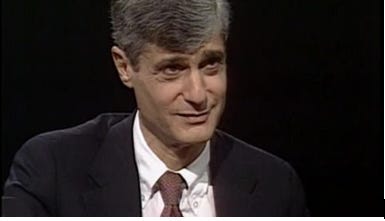
Robert Rubin, a fixture at Goldman Sachs for 26 years, was unanimously approved by the senate in 1995 to become Bill Clinton’s Secretary of the Treasury. He remained at that post until July 1999, when he took a position on the board of Citigroup, at a $15 million a year salary. While at the treasury, he helped create a deregulated economic vehicle which he put in operation once he joined Citigroup.
Treasury Secretary, Rubin and his Under Secretary, Larry Summers, began guiding and grooming a young Timothy Geithner, who had been a part of the Treasury Department since 1988, at 27 years of age. Rubin and Summers developed a relationship with Geithner that assured mutual protection of each other’s reputation and wealth if ever the case would arise.
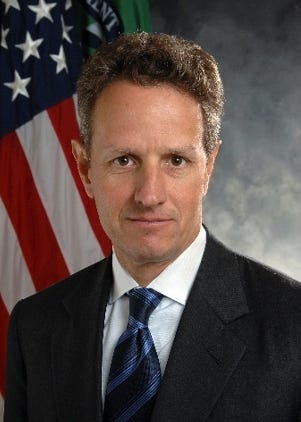
When President George W. Bush took office on January 20th 2001, Geithner left the Treasury Department. On October 15th, 2003, the New York Fed's Board of Directors appointed Geithner president and CEO of the Federal Reserve Bank of New York. The Federal Reserve Bank of New York is a private firm owned by some of the largest investment banks in the US including, JPMorgan Chase, Citigroup, Goldman Sachs, Morgan Stanley, and Bank of New York Mellon. Not to be confused with the public entity, the Central Bank of the United States, which is governed by the Federal Reserve Board in Washington, D.C.
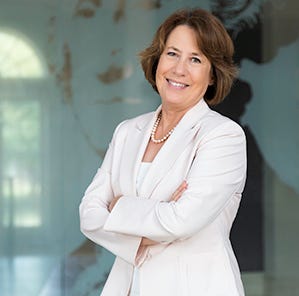
Geithner remained in that position for over 5 years while playing a substantial role in protecting Rubin and the insolvent Citigroup from lapsing into bankruptcy. This was achieved by working in coordination with Treasury Secretary Hank Paulson to pump billions of dollars into Citi’s black hole of losses, while trying to convince the public that Citi was doing fine. Federal Deposit Insurance Corporation (FDIC) Chair at the time was Sheila Bair, who later reported:
By November (2008), the supposedly solvent Citi was back on the ropes, in need of another government handout. The market didn’t buy the OCC’s and NY Fed’s strategy of making it look as though Citi was as healthy as the other commercial banks. Citi had not had a profitable quarter since the second quarter of 2007… (Its losses) were attributable to weak management, high levels of leverage, and excessive risk taking. It had major losses driven by their exposures to a virtual hit list of high-risk lending; subprime mortgages, ‘Alt-A’ mortgages, ‘designer’ credit cards, leveraged loans, and poorly underwritten commercial real estate.
By the time the hemorrhaging at Citigroup stopped, 2.5 trillion dollars of “taxpayer capital, guarantees and loans” had disappeared.
Economist Michael Hudson in his book, Killing the Host, states that Rubin, “oversaw its (Citigroup’s) descent into insolvency and financial fraud- for which it was later fined tens of billions of dollars.” Of the banks that caused the 2008 crisis:
The most reckless bank was Citigroup… Under Rubin’s direction Citigroup wove its speculative activities into so complex a veil of tiers that when the FDIC regulators thought of taking it over in 2008, they found it impossible to untangle the maze to find out who owed how much to whom, and how to evaluate the complex derivatives at the heart of Citigroup’s loss.
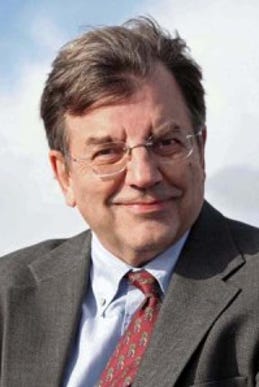
Larry Summers
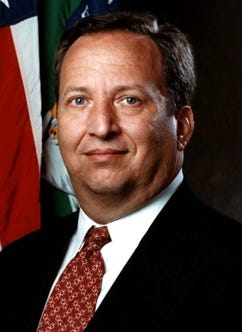
Larry Summers, took the place of Rubin as the Secretary of the Treasury in July of 1999. Pam and Russ Martens recount Summers’ words at the signing ceremony for the Gramm-Leach-Bliley Financial Act on their financial watchdog website, Wall Street on Parade. This signing sounded the death knell to Glass-Steagall Act, and an end to any meaningful regulation of the Wall Street investment banking behemoths.
Let me welcome you all here today for the signing of this historic legislation. With this bill, the American financial system takes a major step forward towards the 21st century, one that will benefit American consumers, business, and the national economy for many years to come…I believe we have all found the right framework for America’s future financial system.
The Martens remind their readers,
Just nine years later, that framework heralded by Summers brought on the worst financial collapse on Wall Street and in the U.S. economy since the Great Depression… Summers’ promise that the repeal would be ‘the right framework for America’s future financial system’ has turned out to be a twisted, cruel fantasy.
Michael Hudson, tracking Summer’s trajectory writes, “Summers went on to become the President of Harvard, where he lost $1 billion in derivatives speculation, and then became Obama’s chief economic advisor.” In 2006 Summers resigned as president of Harvard in the wake of a vote of lack of confidence from the Faculty of Arts and Sciences.
Alan Greenspan
When Alan Greenspan stepped down as chairman of the Federal Reserve in January of 2006, he was the undisputed godfather of financial deregulation, with chairman of the Senate Banking Committee, Phil Gramm hovering close behind. On February 15th,1999, the cover of Time Magazine crowned him as part of the “Committee to Save the World.” Ten years later, in February of 2009 when the financial collapse was in full-swing, Time Magazine produced a list of The 25 People to Blame for the Financial Crisis. Greenspan came in as the 3rd most blame worthy person for the debacle.
Time listed the “American Consumer” in 5th place, in front of former Secretary of the Treasury, Henry Paulson ranked 6th. That placement begs comment. How was the typical American consumer, who knew little to nothing about finance, more responsible for the financial crisis than Hank Paulson? How would “Jane Average” have the time and tools to do the research to discover that Paulson, Geithner, and many others, were lying through their teeth when they said that, if the insurance company, American International Group (AIG) went bankrupt, that “main street Jane Average” would suffer more than anyone else?
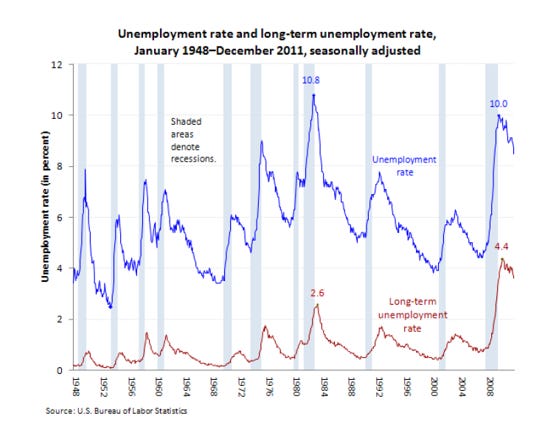
What actually happened was that AIG didn’t go bankrupt, but was rescued by Jane Average’s tax dollars. Then unemployment doubled, Jane lost her job, and the people Jane helped rescue came and took possession of Jane’s house, and kicked Jane to the curb. And to put the toxic icing on the maggot infested cake, Jane paid the salaries of the public servants who made this happen. Was Jane Average’s culpability rooted in the fact that she was just doing what she was told, by people who were stamped with approval by several US Presidents and many members of the US Congress, assuring her that they were people Jane could trust to protect her?
Economist Michael Hudson explains the false narrative that was being spread about AIG in his book, Killing the Host:
AIG was, after all, one of the largest providers of property and other forms of insurance. But its basic “vanilla” insurance business didn’t need bailed out. Well regulated by local state agencies, it never faced a threat of insolvency, because its local offices for property and life insurance were well backed… the Treasury’s payments to AIG’s Wall Street counterparties had nothing to do with saving Main Street’s retail life insurance and casualty policyholders.
A Wall Street Journal article on March 3rd, 2009, concurred:
The Treasury (Paulson) and the New York Fed (Geithner) appear eager to show that continuing to pour money into AIG is about saving Main Street, not just Wall Street. But…state laws segregate the assets needed to protect policyholders within the highly regulated insurance subsidiaries of AIG, and if they were to fail, state guarantee funds exist to ensure claims are paid.
So did the New York Superintendent of Insurance, Eric Dinallo:
If AIG had gone bankrupt, state regulators would have seized the individual (local) insurance companies. The reserves of those insurance companies would have been set aside to pay the policyholders and thereby protected from AIG’s creditors.
Who was not on Time Magazines List?
What is surprising is who is not on the list. Fed. Reserve Chair, Ben Bernanke nor Geithner were listed in the Time magazine rankings. I guess their part in helping Paulson pull AIG out of the quicksand, so that it could use US taxpayers bailout money (180 Billion), to churn a feeding frenzy for virtually every financial piranha in the fish bowl who was responsible for the crisis, didn’t count. The bottom line was, AIG owed the mega banks money and they were going to cough it up one way or another.
On March 15, 2009 the New York Times printed a list of Wall Street recipients who received bailout funds through AIG. This list illuminates for the reader who was in control of the money spigot. Each of the CEO’s listed below received huge bonuses before and after the bailouts. None are on Time Magazine’s list.
$12.90 Billion to Goldman Sachs CEO Lloyd Blankfein (Paulson’s Successor)
$12.00 Billion to Société Générale Bank (France) CEO Frédéric Oudéa
$12.00 Billion to Duetsche Bank (Germany) CEO Josef Ackermann
$ 8.50 Billion to Barclays Bank (Britain) Chairman Marcus Agios
$ 6.80 Billion to Merrill Lynch CEO John Thain
$ 5.20 Billion to Bank of America CEO Ken Lewis
$ 5.00 Billion to UBS (Switzerland) CEO Marcel Rohner
$ 2.30 Billion to Citigroup CEO Vikram Pandit (Rubin’s successor)
$ 1.50 Billion to Wachovia Interim CEO- Treasury Under sec. Bob Steel
Total $ 66.20 Billion
2023 Net Worth List of some of those who profited from the crisis.
Robert Rubin $100 Million
Larry Summers $40 Million
Hank Paulson’s $700 million
Alan Greenspan $20 million
Tim Geithner $12 million
Ben Bernanke $5 million
Angelo Mozilo (Country Wide) $600 Million
Joe Cassano (AIG) $200 Million
Lloyd Blankfein (Goldman Sachs) $1 Billion
Jimmy Cayne (Bear Stearns) $100 Million
Dick Fuld (Lehman Brothers) $205 Million
Stan O'Neal (Merrill Lynch) $70 Million
Sandy Weill (Deregulation lobbyist) $1 Billion
Jimmy Cayne (Bear Stearns) $100 Million
The pink elephant in the room.
In December of 2011, Economists James Felkerson and Nicola Matthews, at the University of Missouri, Kansas City, in coordination with the Levy Economic Institute of Bard College, plowed through 25,000 pages of raw data on the bailouts that the Federal Reserve was ordered by the courts to provide. In the 36 page paper they produced, detailing their findings, a conclusionary statement reads, “We have conducted the most comprehensive investigation of the raw data to date. We find that the total spending (of the bailouts) is actually over $29 Trillion… (this) cumulatively amounted to over twice current US gross domestic product.”
Finance capitalists claim that a truly “free market” financial system functions best when there is no government interference. And yet, in the financial crisis of 2007-2010, Secretary of the Treasury, Henry Paulson ( 07.10.06 – 01.20.09), Federal Reserve Chair, Ben Bernanke (02.01.2006 – 01.23.2014), and Secretary of the Treasury, Timothy Geithner (01.26.2009 – 01.26.2013), with a chorus of others- these protectors of the Finance Capital elites, their banks, and their system - diligently and incessantly told congress, regulators, and the US Public, that government intervention was absolutely necessary to prevent a financial collapse of the markets.